
Imagine waking up one morning to discover that everything you own has disappeared beneath floodwaters.
Imagine spending months cultivating your farm, only to watch your crops wither because the rains never came.
Imagine leaving your hometown because the land that once sustained your family has become a source of conflict and violence.
For thousands of Nigerians, these are not imaginary stories. They are real. And they are becoming more common.
That is why the National Human Rights Commission (NHRC) says climate change is no longer just an environmental issue. It is a human rights issue.
Every flooded community, every displaced family, every child forced out of school by disaster, every farmer who loses a harvest and every community struggling to survive tells a story that deserves attention.
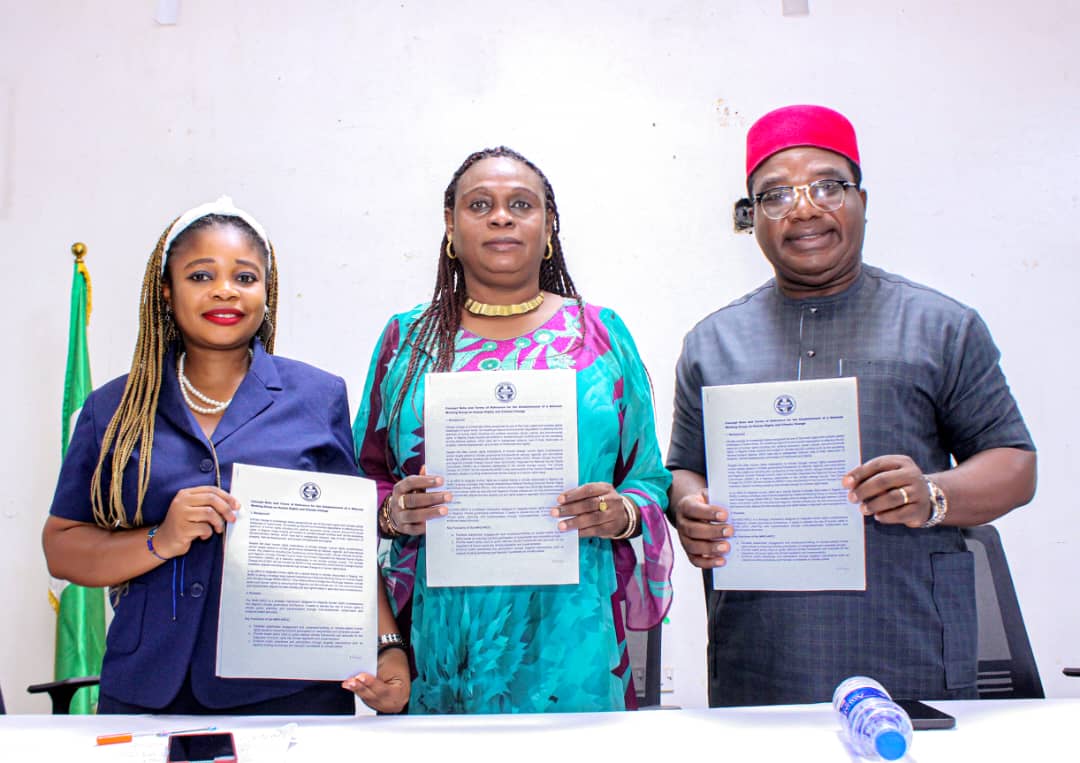
At the inauguration of the National Working Group on Human Rights and Climate Change in Abuja, the Executive Secretary of the NHRC, Chief Tony Ojukwu, OFR, SAN, challenged Nigerians to see climate change differently. "It's not just about rising temperatures," he said. "It's about people." "It's about families losing their homes, farmers losing their livelihoods, communities being uprooted and vulnerable people falling deeper into poverty."
He asked a simple but powerful question that should guide every climate policy: How does it affect people?
That question is at the heart of the newly inaugurated National Working Group, a partnership between the NHRC, the Federal Ministry of Environment and the National Council on Climate Change.
Its mission is simple but profound—to ensure that while Nigeria fights climate change, it also protects the rights and dignity of its people.
The Working Group will bring together government institutions, civil society organisations, academics and development partners to ensure that those most affected are no longer left out of the conversation.
Representing the Honourable Minister of Environment, Dr. Iniobong Abiola Awe assured Nigerians that the Ministry is committed to climate policies that leave no one behind.
For the Director-General of the National Council on Climate Change, Dr. (Mrs.) Omotenioye Majekodunmi, the evidence is impossible to ignore, flooding, migration, farmer-herder conflicts, rising temperatures. These are no longer isolated environmental problems. They are daily realities affecting lives, livelihoods and human dignity across the country.
Civil society also lent its voice. Founder of the Women Environmental Programme, Dr. Priscilla Achakpa, pledged continued support for climate justice, especially for women, young people and other vulnerable groups whose voices are often unheard.
The Federal Commissioner for Refugees, Migrants and Internally Displaced Persons, Aliyu Tijani Ahmed also reaffirmed its commitment to protecting people displaced by climate-related disasters. The Federal Commissioner was represented at the occasion by former Director at the NHRC, Mr. Dahiru Bobbo. While the Presidency, through the Special Assistant to President Bola Ahmed Tinubu on Climate Change, Comrade Yussuf Olatunji Kelani, promised support for the Working Group's activities.
But beyond the speeches and the inauguration, one message stood out. Climate change is not just about the planet. It is about the people who call it home. It is about the child whose classroom is destroyed by floods. The mother wondering where the next meal will come from after her crops fail.
The young graduate forced to abandon his community because life there is no longer sustainable. Their stories matter. Their rights matter. And their future matters.
For the NHRC, the inauguration of the National Working Group is not simply the launch of another committee. It is a promise.
A promise that as Nigeria responds to climate change, people, not just policies will remain at the centre of every action. Because protecting the climate should also mean protecting humanity.
After all, when people suffer because of climate change, protecting human rights becomes everyone's responsibility.


